
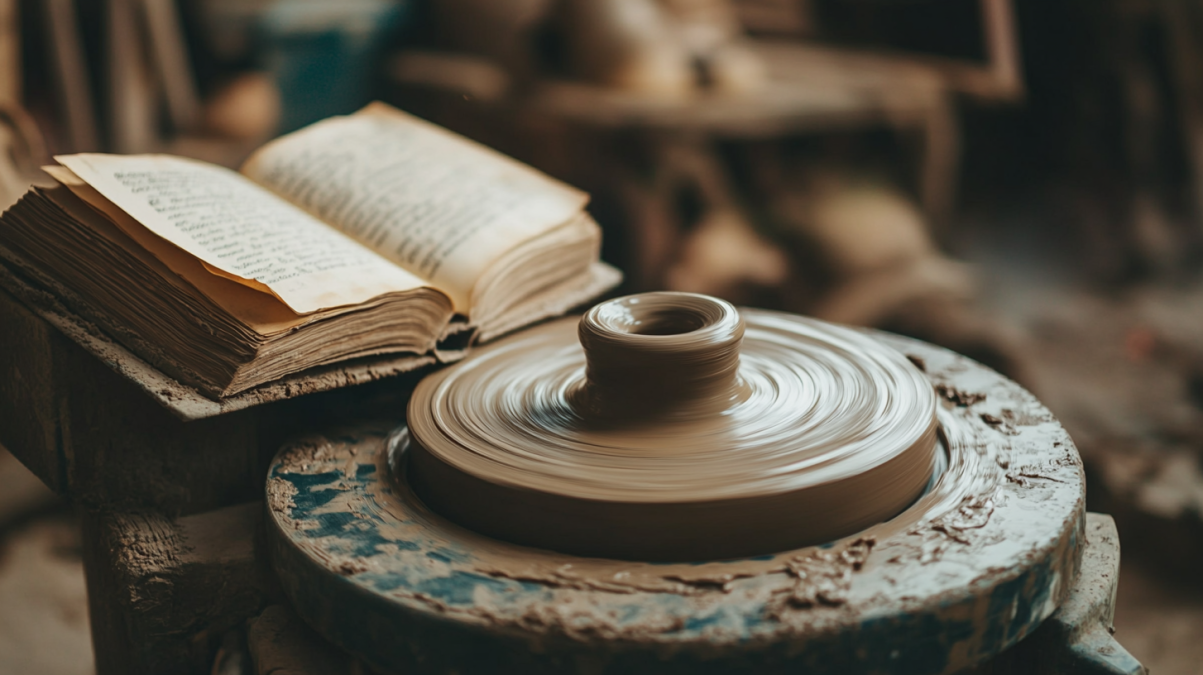
Dear friends and fellow travelers on this earthen path, welcome to the world where clay and verse intertwine. Today, we’ll explore the poetic nature of pottery, finding the meter in our hands and the rhyme in our creations. As the venerable T.S. Eliot once wrote, “At the still point of the turning world… there the dance is.” And oh, what a dance we have with clay!
The Sonnet of the Wheel
Let us begin where many potters do – at the wheel. There’s a sonnet in every revolution, a meter in the steady hum as it spins. Your hands, dear reader, are the poet’s pen, shaping stanzas from humble earth.
As you center your clay, remember the words of Mary Oliver: “Instructions for living a life: Pay attention. Be astonished. Tell about it.” Center yourself as you center the clay. Feel the cool slip between your fingers, the resistance as the wheel turns. This is the first line of your poem, the opening volta of your ceramic sonnet.
In my many years at the wheel, I’ve found that centering clay is much like centering oneself in life. It requires patience, a gentle touch, and the wisdom to know when to apply pressure and when to yield. How often have I sat down, mind cluttered with the day’s worries, only to find peace in the rhythmic motion of the wheel?
The Free Verse of Hand-Building
But not all pottery adheres to the strict meter of the wheel. Hand-building, my dears, is the free verse of our craft. Here, we abandon the structure of the wheel for the liberating formlessness of slabs and coils.
As you roll out a slab or pinch a pot into being, think of e.e. cummings and his delightful disregard for conventional form. Your hands can wander, exploring the terrain of possibility. A dimple here, a smooth plane there – each choice a word in your tactile poem.
I remember teaching a group of children to hand-build pots. Their uninhibited creativity was a joy to behold. One young girl created a lopsided bowl with a dozen tiny feet. “It’s for a centipede’s cereal,” she declared proudly. Oh, how we can learn from the unfettered imagination of youth!
The Haiku of Glazing
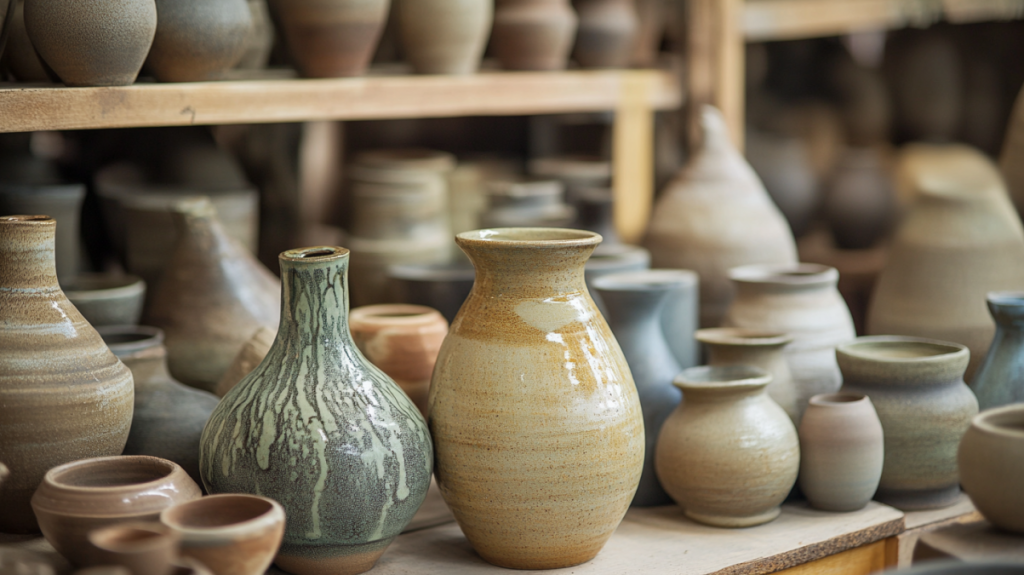
Glazing, my friends, is the haiku of our art. It requires a keen eye, a steady hand, and the ability to say much with little. A single brush stroke can transform a piece, like the season word in a haiku that shifts the whole meaning.
Consider the celadon glazes of ancient Chinese pottery, how a single hue could capture the essence of jade, of misty mountains, of eternity itself. When you approach your pieces with glaze in hand, take a moment to consider the essence of your creation. What does it whisper to you? What single stroke might give voice to its silent song?
I once spent an entire afternoon glazing a single bowl, trying to capture the exact shade of a robin’s egg I’d found in my garden. Hours passed like minutes as I mixed and tested, each attempt bringing me closer not just to the color, but to an understanding of the fragile beauty it represented.
The Epic of the Kiln
And then, dear readers, we come to the kiln – the crucible where our poetic efforts are put to the test. Loading a kiln is like crafting an epic poem. Each piece must be placed with care, with an understanding of how it relates to the whole.
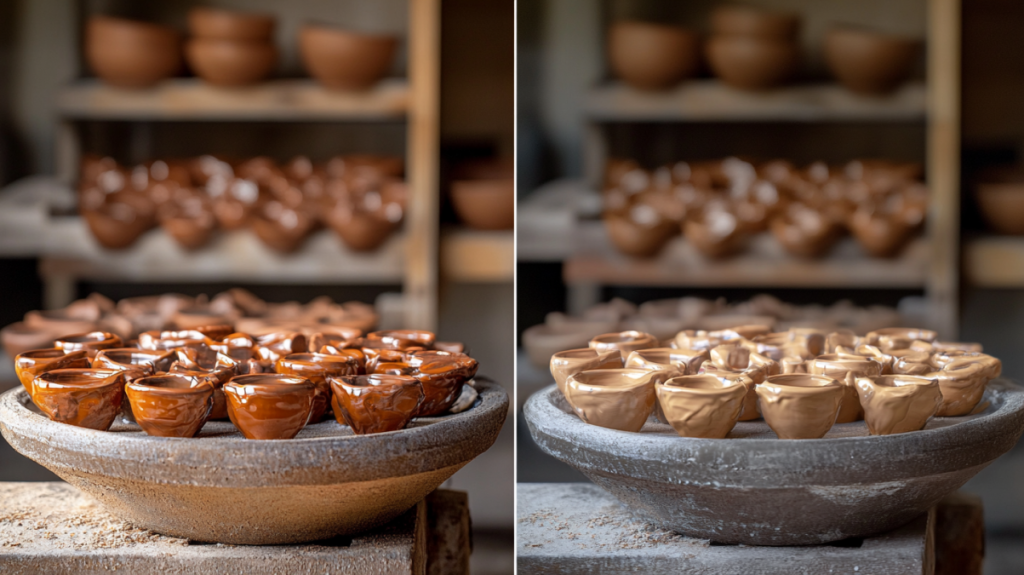
The firing itself is the hero’s journey, the transformation at the heart of every great tale. We close the kiln door and send our creations into the inferno, hoping they emerge transformed, like Dante ascending from the underworld.
I’ll never forget the anticipation of my first glaze firing. I paced my studio like an expectant father, imagining all the possibilities – and potential disasters – that awaited. When I finally opened the kiln, the sight of my creations, now permanent and gleaming, brought tears to my eyes. Each piece was a verse in the epic of my growth as a potter.
The Wisdom in Imperfection
Now, my dears, let us speak of wabi-sabi, the Japanese aesthetic that finds beauty in imperfection. In pottery, as in life, imperfections are not flaws to be hidden, but unique marks to be celebrated. A finger mark here, an unexpected glaze drip there – these are the things that make your work uniquely yours.
Remember the words of Leonard Cohen: “There is a crack in everything. That’s how the light gets in.” Embrace the unexpected twists in your clay poems. That bowl that warped in the firing? Perhaps it’s meant to hold the curves of a perfect apple. The glaze that ran? Maybe it’s captured the essence of a waterfall.
The Ongoing Stanza
As we come to the end of our reflections, remember that pottery, like poetry, is a practice without end. Each piece you create is a stanza in the ongoing poem of your life. Your hands will continue to learn, to explore, to create long after the clay has dried and the glaze has cooled.
So, my fellow poets of the earth, I encourage you to approach your craft with the heart of a wordsmith. Find the rhythm in the clay, the meter in the wheel, the rhyme in the glaze. Let each piece you create be a verse in the grand poem of your artistic journey.
And when you find yourself frustrated, when the clay refuses to bend to your will or the glaze misbehaves, remember the wise words of Samuel Beckett: “Ever tried. Ever failed. No matter. Try again. Fail again. Fail better.” For in pottery, as in life, it is not perfection we seek, but growth, expression, and the joy of creation.
Now, if you’ll excuse me, I believe my kiln is cooling, and a new set of ceramic verses awaits my eager eyes. Until next time, may your hands be dirty, your heart be full, and your poetry in clay be ever-evolving.
